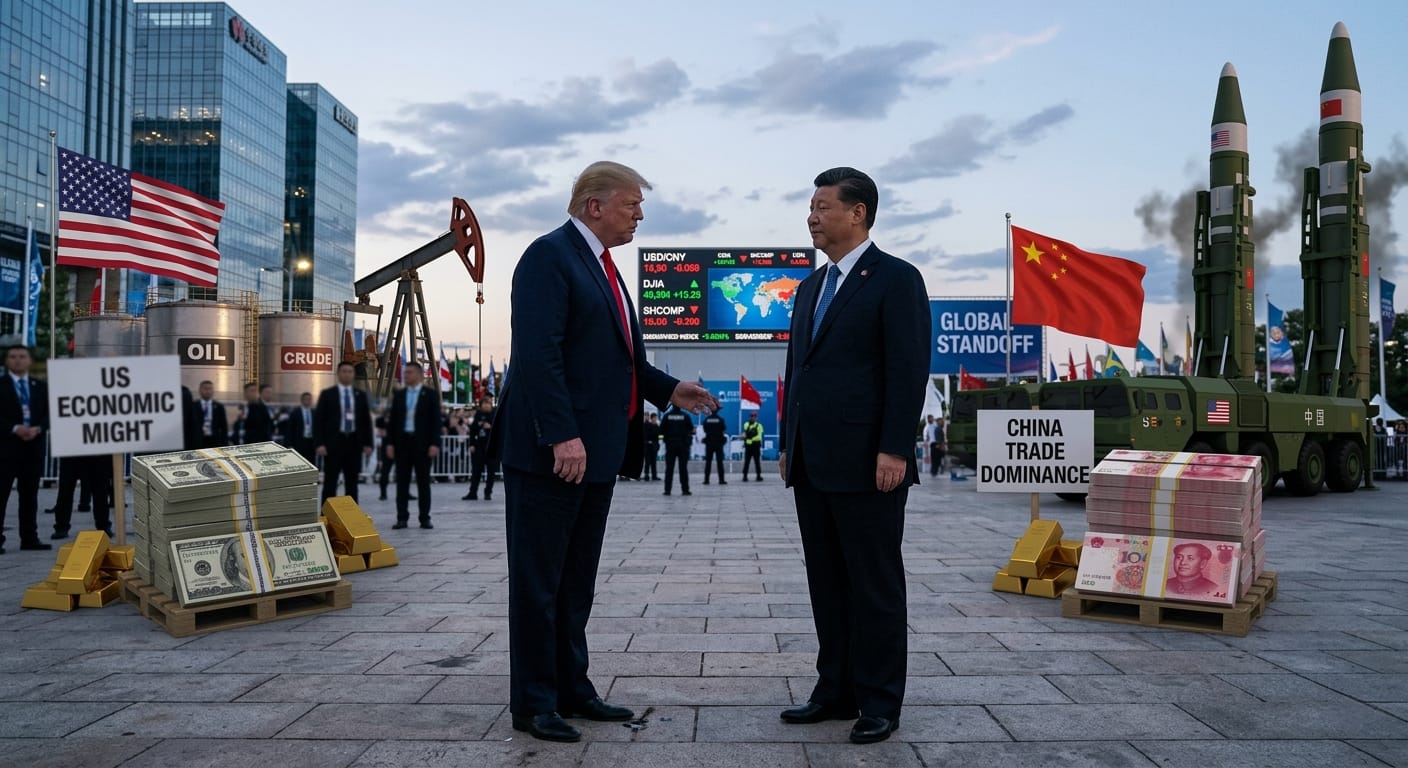

The US-Iran War Strategy currently unfolding under the Trump administration has left global analysts searching for answers. While the official mission began with the goal of neutralising nuclear facilities and dismantling ballistic missile programs, those objectives have largely been met. Iran’s nuclear capabilities are crippled, and its military infrastructure has been set back by a decade. Yet, the bombs are still falling. This persistence reveals a much deeper, more aggressive geopolitical playbook: the “Mother Goal” doctrine.
As we analyse the current global energy crisis, it is becoming clear that the US-Iran War Strategy is not just about Tehran. It is a calculated move to “choke down” the rise of China by targeting its most vital dependencies. In this long-read analysis for Morning Draft, we break down the seven brutal truths of why this conflict is actually a war for the 21st-century world order.
1. The Energy Chokehold: Choking China’s Lifeblood
The cornerstone of the US-Iran War Strategy is the weaponisation of energy. China is the world’s largest importer of crude oil, and its economy is famously energy-hungry. By launching a two-pronged offensive—first in Venezuela to remove the Maduro regime, and then in Iran—the U.S. has targeted the two nations responsible for nearly 20% of China’s total oil supply.
Iran alone sells 90% of its crude to Beijing. By neutralising these suppliers, Trump has effectively placed China on an energy leash. This “Chokehold Doctrine” serves as a direct retaliation for China’s dominance in rare earth materials, proving that while China may control the minerals of the future, the U.S. still controls the fuel of the present.
2. Exposing the Myth of Chinese Military Technology
A secondary but vital feature of the US-Iran War Strategy is the live-fire exposure of Chinese military failures. For years, Beijing has marketed its HQ-9B missile defence systems and JY-27 radars as the gold standard for resisting Western intervention.

The reality in Iran and Venezuela has been embarrassing for Beijing. These systems failed to detect U.S. stealth aircraft and drones. In Iran, the total failure of Chinese air defence led to the death of Supreme Leader Ayatollah Khamenei and 49 high-ranking officials. By discrediting Chinese defence technology on the battlefield, the U.S. is destroying China’s credibility as a military partner for other nations.
3. The Collapse of the $400 Billion Belt and Road Investment
The US-Iran War Strategy has struck a fatal blow to China’s “Belt and Road Initiative” (BRI). China had committed over $400 billion to Iran’s infrastructure, banking, and energy sectors to secure a permanent foothold in West Asia.
With the current war and the impending “regime change” that experts believe is inevitable, these investments are now essentially worthless. Trump is not just fighting a war; he is bankrupting China’s decades-long expansionist project, effectively pushing Beijing out of the Middle East entirely.
4. Dismantling the Yuan Supremacy and Petro-Yuan

One of the most dangerous threats to the U.S. was the shift away from the Dollar. Iran and Venezuela had begun accepting Chinese Yuan for oil, a move that threatened the global dominance of the “Petrodollar.”
A major, though unspoken, part of the US-Iran War Strategy is to crush this emerging Petro-Yuan trade. By destroying the oil trade of these nations, the U.S. is reasserting the Dollar’s role as the only currency that matters in the global energy market, forcing the world back into the American financial orbit.
5. The $100 Million-a-Day Attrition of Allies
As we discussed in our recent analysis of the Dubai Airport attack, the cost of this war is asymmetrical. While the US-Iran War Strategy targets China, it is also bleeding U.S. allies like the UAE.
Iran is using $35,000 drones to force the UAE to fire $12 million interceptor missiles. Trump’s strategy appears to involve letting this attrition continue until his regional allies have no choice but to fully support a total regime change in Tehran, regardless of the temporary economic cost to their own cities.
6. Weaponising Regime Change for Global Leverage
Regime change is the final stage of the US-Iran War Strategy. In Venezuela, the U.S. has already installed a new administration that has agreed to prioritise oil exports to the West rather than China. Experts predict the same for Iran.
By installing Western-friendly governments in the world’s most oil-rich nations, the U.S. creates a permanent barrier for China. If Beijing wants oil, it will soon have to buy it from nations that take their orders from Washington, not Beijing.
7. The New Cold War: Technology vs. Resources

Ultimately, the US-Iran War Strategy reveals that the new Cold War is a battle of “monopolies.” China tried to use its monopoly on rare earth minerals to “choke” U.S. defence companies. Trump responded by using the U.S. monopoly on military technology and global shipping routes to “choke” China’s energy.
It is a brutal, high-stakes game of geopolitical chess where Iran is simply the board. The U.S. is betting that its ability to disrupt resources is more powerful than China’s ability to manufacture technology.
The Bottom Line
The US-Iran War Strategy is the most significant shift in American foreign policy since the end of the Cold War. It is a doctrine that moves beyond regional stability and focuses entirely on the containment of a rival superpower. By the time the smoke clears, the Middle East will be transformed, but the real winner or loser will be decided in the boardrooms of Beijing and the halls of Washington.
As the Iran War Cost Tracker continues to tick upward, the question remains: Can the global economy survive the “Mother Goal” doctrine, or will the cost of containing China be the collapse of the very world order the U.S. seeks to protect?
Do follow or page: The Morning Draft