
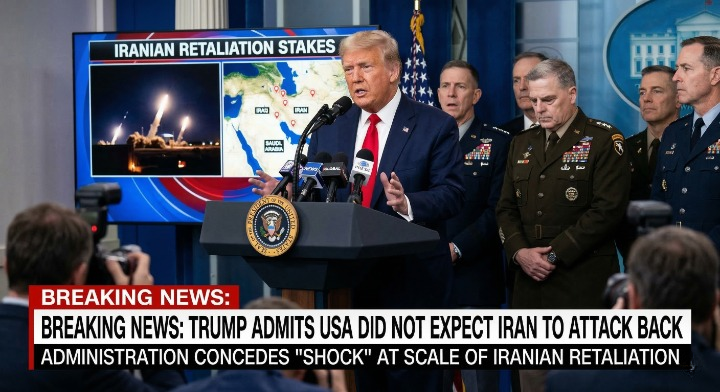
IRAN SHOCKED USA ADMITS TRUMP | USA Did not expect Iran to Attack Back
As the US-Iran conflict grinds into its 18th day, the narrative of a quick, surgical operation has completely evaporated. For decades, the United States military machine operated on a simple, foundational assumption: overwhelming force guarantees swift victory, and the targets rarely hit back directly. From Iraq to Afghanistan, that rule held firm. But over the last two and a half weeks, the escalating US-Iran conflict has brought that era of unopposed American intervention to a screeching halt.
In a startling admission that has sent shockwaves through the global intelligence community Donald Trump has conceded a harsh reality: the United States gravely miscalculated Iran’s capabilities and its sheer willingness to fight back.
The End of Easy Victories in the US-Iran Conflict

For months, we watched the rhetoric build up—bold claims about operations, fighter jets, and American might. Many brushed it off as standard political theater. But the reality on the ground is now catching up. The core of this shock within the US-Iran conflict lies in the sheer audacity of Tehran’s retaliation. The US establishment seemingly expected Iran to absorb the strikes and quietly yield, much like other nations targeted by American firepower in the past.
Instead, Iran unleashed a barrage of missiles targeting key US allies and installations across the Middle East—hitting zones in Saudi Arabia, Qatar, the UAE, Bahrain, and Kuwait. This unprecedented counter-offensive caught the Pentagon completely off guard. The US is now scrambling to pull air defense systems from as far away as South Korea, and the reported downing of advanced US fighter jets is a staggering blow to American air superiority.
The Human and Economic Toll
The cost of this miscalculation is already devastating. Over 2,000 lives have been lost in just 18 days. The vast majority of these casualties are civilians, a stark reminder that behind every statistic are shattered families and destroyed communities. With no de-escalation in sight, there are grave fears this number could spiral to 10,000 or 20,000 in the coming months.
Beyond the human tragedy, the economic fallout is beginning to bite globally. Crude oil has surged to $105 per barrel. If the US-Iran conflict drags on past March—which seems highly likely—this massive spike in energy costs will inevitably trigger inflation and market instability worldwide.
India’s Role as a Global Mediator in the US-Iran Conflict

As the situation deteriorates, the international community is desperately searching for an off-ramp. A complex conflict involving three heavily armed players with deep-seated interests requires a mediator with exceptional diplomatic standing. Interestingly, Western leaders are increasingly looking toward New Delhi.
Finland’s President recently suggested on record that Indian involvement might be the key to a ceasefire. Why India? Simply put, it’s arguably the only major global power that maintains strong, functional relations with both Washington and Tehran. External Affairs Minister Dr. S. Jaishankar has already called for an immediate ceasefire to cool regional temperatures, and the passage of two Indian naval ships through the volatile Strait of Hormuz underscores India’s strategic stakes in the area.
But brokering peace in the US-Iran conflict is a monumental task. Iran, emboldened by its resistance and aggrieved by the unprovoked destruction of its infrastructure, will likely demand astronomical concessions. We’re looking at demands for ironclad, written assurances against future attacks and massive financial reparations. For the US, agreeing to such terms would be a bitter, politically humiliating pill to swallow.
The Diversion Strategy: Looking at Cuba

Faced with a disastrous quagmire in the Middle East and the potential destruction of a strongman image, the US administration appears to be looking for a geopolitical distraction. There is a chilling pivot happening in American foreign policy discourse right now: signals of a potential military offensive against Cuba.
The cynical logic is clear. Cuba is essentially in America’s backyard, lacking the sophisticated military apparatus and regional backing that Iran possesses. Conquering or “liberating” Cuba would offer a relatively easy military victory, providing a much-needed domestic PR win to mask the ongoing failures in the US-Iran conflict. When recently asked about Cuba, Trump ominously blended the language of conquest with freedom, suggesting he would either “capture it or liberate it.” This reveals a dangerous expansionist mindset, with some analysts even speculating a revived push to annex Greenland if the situation in Iran worsens.
The Proxy War Expands
This isn’t just a bilateral issue anymore; it’s rapidly evolving into a proxy war. Recent reports indicate that Russia and China have stepped in, funneling critical military support to Tehran to help rebuild its capabilities.
Moscow and Beijing understand the geopolitical math: the longer the US is bogged down in a costly, unwinnable US-Iran conflict, the more its global hegemony erodes. By backing Iran, they are actively bleeding American resources and accelerating the shift toward a multipolar world order.
The Bottom Line
The US-Iran conflict of early 2026 will likely go down as a watershed moment in modern warfare. The hubris of expecting an easy victory has led to a devastating trap. With thousands dead, markets trembling, and the myth of unchecked American invincibility shattered, the world is on a knife’s edge. Whether this ends in a humiliating withdrawal or a chaotic expansion into new fronts remains to be seen. But one thing is clear: the geopolitical tectonic plates have shifted, and the rules of the game will never be the same.
Do follow our page: https://themorningdraft.com/