
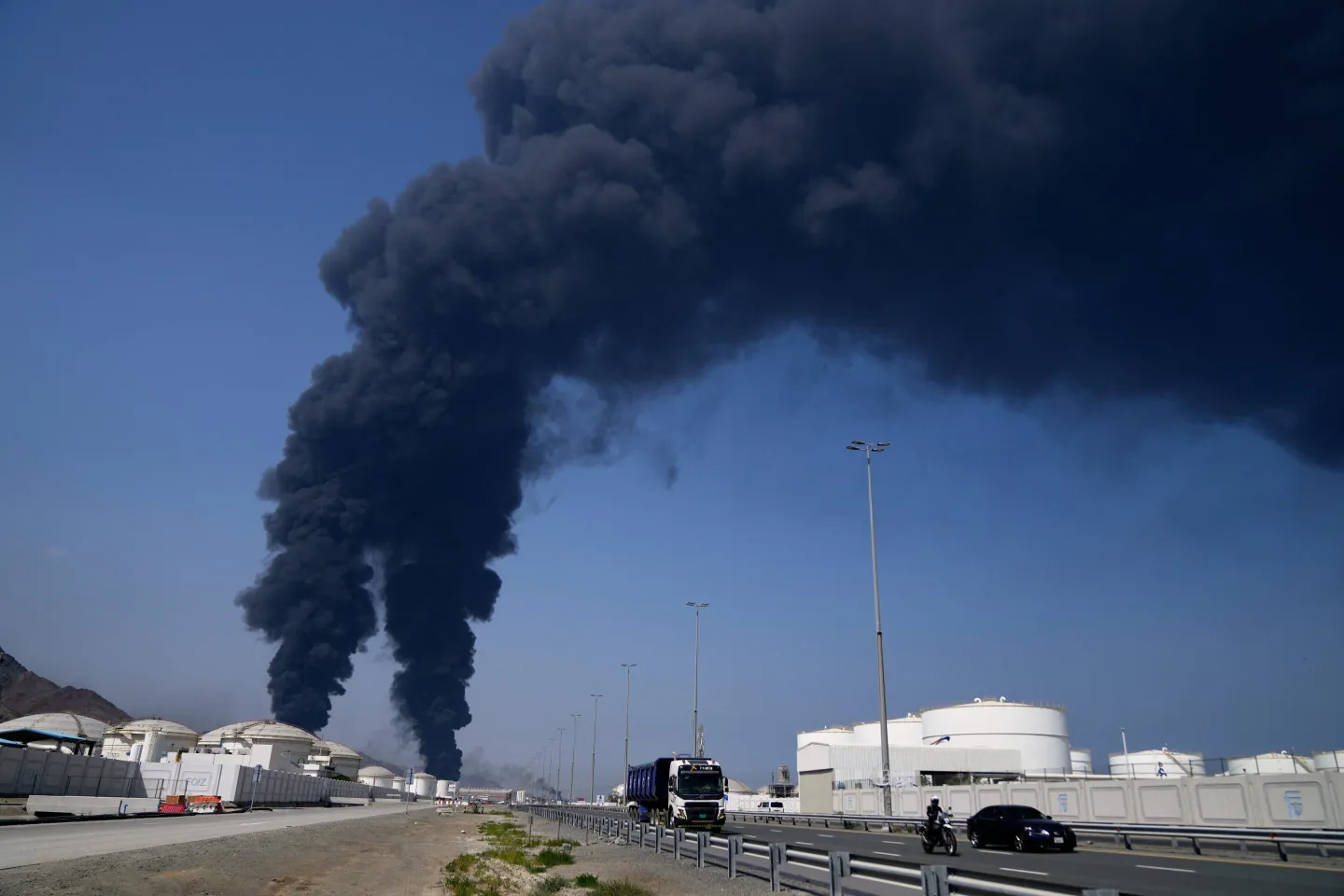

The Dubai Airport attack on March 16, 2026, has sent a clear and terrifying message to the world: the “Safe Haven” of the Middle East is under siege. As a thick shroud of black smoke billowed over the runways of the world’s busiest international terminal, the geopolitical landscape shifted. A single drone strike on a fuel farm didn’t just ignite a fire; it ignited a global aviation crisis. Yet, in the wake of the Dubai Airport attack, the United Arab Emirates has remained uncharacteristically silent, refusing to launch a single missile back at Tehran.
For those of us tracking the global energy markets, the implications are staggering. This isn’t just about a regional spat; it’s a targeted strike on the jugular of global commerce. To understand why the UAE is choosing strategic restraint, we must look at the brutal economic and military realities that have followed the Dubai Airport attack.
1. The Total Paralysis of Global Aviation
The primary goal of the Dubai Airport attack was never total physical destruction; it was disruption. Dubai International (DXB) serves as the primary artery connecting the West to the East. Within an hour of the strike, the UAE government imposed “Extraordinary Aviation Restrictions,” indefinitely halting all international flights.
The International Air Transport Association (IATA) reports that this closure has left tens of thousands of passengers stranded and forced major carriers like Air India, IndiGo, and Lufthansa to cancel all operations into the Emirates. By taking DXB off the map, the Dubai Airport attack has effectively severed the transit hub for Europe, Asia, and Africa, creating a backlog that could take weeks to clear once—or if—the skies reopen.
2. The $100 Million Per Day Bleed
When we talk about the Dubai Airport attack, we are talking about a financial catastrophe. Unlike neighboring states whose power is measured in barrels of oil or missile counts, the UAE’s power is built on its reputation for stability and luxury.
The numbers are eye-watering:
Emirates Airline: Currently losing an estimated $100 million every 24 hours.
Jebel Ali Port: Suffering a $500 million daily loss in logistics revenue.
Investor Confidence: Markets have already seen a $5 billion flight of capital since the strikes began.
The UAE knows that a direct military retaliation would turn a temporary disruption into a permanent war footing, permanently scaring away the foreign investors and tourists who serve as the lifeblood of the nation.
3. The Threat to the Burj Khalifa

Why hasn’t the UAE responded to the Dubai Airport attack? The answer is “Symmetry.” If the UAE launches a strike on Iranian soil, the response would likely target the crown jewels of Emirati architecture.
Intelligence reports suggest that Iran possesses “drone swarms” capable of overwhelmed even the most advanced defense systems. If 500 drones were launched simultaneously, a percentage would inevitably strike the Burj Khalifa or the Palm Jumeirah. The UAE is playing a high-stakes game of poker where they have the most to lose in terms of infrastructure. They are choosing to absorb the cost of the Dubai Airport attack rather than risk seeing the Dubai skyline in ruins.
4. The Failure of the “Safety” Buffer
For years, the UAE has invested in ports like Fujairah to bypass the volatile Strait of Hormuz. The logic was simple: if Iran closes the Strait, the oil still flows from the coast of the Gulf of Oman. However, the Dubai Airport attack was accompanied by simultaneous strikes on Fujairah’s bunkering hubs.
This proves that there is no longer a “safe zone” in the Emirates. Iran has demonstrated that its reach extends beyond the Persian Gulf, rendering billions of dollars of “strategic bypass” infrastructure vulnerable. The Dubai Airport attack was a proof-of-concept for a total regional blockade.
5. Strategic Reliance on the US Security Umbrella

The UAE’s military strategy is inherently defensive. While they possess world-class technology, including the THAAD and Patriot missile systems, these are shields, not swords. Following the Dubai Airport attack, the UAE has doubled down on its reliance on the US.
By not retaliating, the UAE maintains its status as the “aggrieved victim” on the global stage, forcing the US and NATO to take the lead in any offensive measures. This keeps the UAE’s hands clean while ensuring that the Al Dhafra Air Base remains the primary center for US-led counter-operations.
6. The 106-to-1 Cost Ratio
One of the most hidden truths of the Dubai Airport attack is the math of modern warfare. As we noted in our recent analysis of the Iran War Cost Tracker (<- Internal Link), the cost ratio is bankrupting the West.
Iran is using drones that cost roughly $35,000 to manufacture. To stop these drones during the Dubai Airport attack, the UAE and its allies are using interceptor missiles that cost between $3 million and $12 million each. It is a war of attrition where the defender spends 100 times more than the attacker. The UAE realizes that it cannot “spend” its way to victory in a protracted missile exchange.
7. The Shadow of the Abraham Accords
Finally, we must address the “Israeli Factor.” The 2020 Abraham Accords transformed the UAE into a key partner for Israeli intelligence and cyber-security. Iran views this as a dagger at its throat. The Dubai Airport attack is Tehran’s way of demanding that the UAE choose: stay allied with Israel and face economic ruin, or distance itself and find peace.
By refusing to retaliate, the UAE is attempting to “freeze” the situation. They are waiting for a diplomatic opening—perhaps brokered by India or another neutral power—to de-escalate without officially breaking their alliances.
The Bottom Line
The Dubai Airport attack has exposed the fragility of the modern global city. In an era of cheap drones and expensive missiles, a nation’s greatest strength—its soaring infrastructure and global connectivity—becomes its greatest vulnerability.
The UAE is not silent because it is weak; it is silent because it is calculated. For Dubai, the only thing more expensive than the current crisis is a full-scale war that would leave its glass towers in the sand. As the smoke clears from the runways, the world watches to see if diplomacy can succeed where interceptors have failed.
Do follow or page: The Morning Draft