
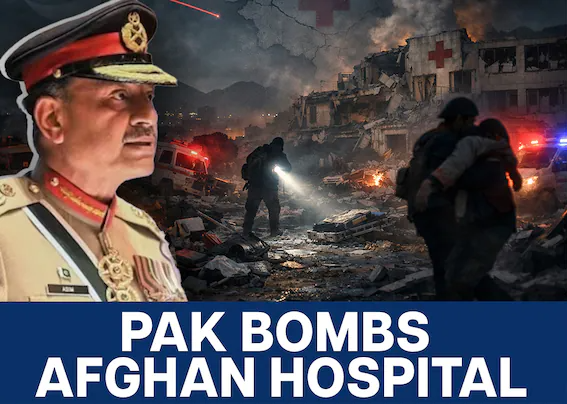

The Kabul hospital attack has sent shockwaves through the Indian subcontinent, marking a horrific new escalation in the ongoing shadow war between Pakistan and Afghanistan. While the eyes of the Western media remain firmly fixated on the escalating US-Iran conflict and the grinding war in Ukraine, a catastrophic humanitarian crisis has just unfolded in the Afghan capital.
Recently, the Pakistani Air Force crossed into Afghan airspace and launched a devastating bombing campaign. Their target was not a hardened military bunker or a terrorist training camp, but a civilian medical facility. The sheer brutality of the Kabul hospital attack has prompted fierce condemnation from New Delhi, while the rest of the world remains deafeningly silent.
To understand the gravity of this geopolitical earthquake, we must look beyond the official denials and examine the strategic manoeuvres happening behind the scenes. Here are the seven brutal truths you need to know about the Kabul hospital attack.
1. A Massacre During the Holy Month of Ramadan

The timing of the Kabul hospital attack adds a layer of profound tragedy to an already horrific event. Conducted during the holy month of Ramadan—a time traditionally reserved for peace, reflection, and mercy among Muslim communities worldwide—this strike defies basic human morality.
The facility targeted was the Umed Addiction Treatment Hospital, a massive 2,000-bed rehabilitation centre in Kabul. According to the Taliban administration, the Pakistani airstrikes on March 16th resulted in the deaths of over 400 people. As rescue operations continue to dig through the rubble, authorities fear that the death toll will rise significantly. Targeting a civilian rehabilitation clinic under the guise of military operations is a clear violation of international law.
2. India’s Firm Official Statement on the Kabul Hospital Attack

While global superpowers have largely ignored the massacre, the Government of India has stepped forward as the lone voice of accountability, issuing a blisteringly firm official statement.
New Delhi categorically condemned the Kabul hospital attack, refusing to mince words. The official Indian response stated: “India completely condemns Pakistan’s barbaric air strike on the Umed Addiction Treatment Hospital in Kabul on the night of March 16. This is a cowardly and unconscionable act of violence.”
The Indian government systematically dismantled any justification Islamabad might offer, stating that a nation whose conscience has died is the only kind that would directly target an addiction treatment centre. The statement powerfully concluded: “This attack was carried out during the holy month of Ramadan, a time of peace, reflection, and mercy among Muslim communities across the world… There is no faith, no law, and no morality that can justify this deliberate targeting of a hospital and its patients.” By officially designating the strike as a “heinous act of aggression,” an “assault on Afghanistan’s sovereignty,” and a “direct threat to regional peace and stability,” India has boldly drawn a line in the sand regarding Pakistan’s unchecked military actions.
3. Pakistan’s Denial and Information Warfare
In the immediate aftermath of the Kabul hospital attack, Islamabad resorted to a familiar tactic: blanket denial. The Pakistani military establishment has vehemently denied targeting the hospital, despite overwhelming visual evidence—images and videos circulating online—that clearly show the destruction caused by their munitions.
This denial is accompanied by a coordinated campaign of information warfare. Pakistani social media accounts and state-aligned commentators have begun circulating claims that the secondary explosions seen in the videos suggest the hospital was secretly housing ammunition and explosives. However, these claims lack credible evidence. Analysts view this as a desperate spin attempt to justify a miscalculated strike or to provide political cover for the deliberate destruction of civilian infrastructure.
4. Afghan Cricketers Break the Silence
One of the most surprising and powerful reactions to the Kabul hospital attack hasn’t come from politicians, but from athletes. While the Afghan government plans its military response, Afghan cricketers have taken to the global stage to voice their outrage.
Star players like Naveen-ul-Haq have fearlessly spoken out, making statements that many international diplomats are too afraid to utter. In a highly publicised social media post, Haq stated that it is “hard to find any difference between Israel and the Pakistani regime.” The Afghanistan Cricket Board has also officially condemned the attack, posting images of the devastated hospital and praying for the victims. This widespread cultural outrage proves that the Kabul hospital attack has permanently fractured any remaining goodwill between the people of Afghanistan and Pakistan.
5. The Real Target: The Bagram Airbase Conspiracy

To understand why Pakistan would risk international outrage with the Kabul hospital attack, we must look at the broader strategic map. Geopolitical analysts argue that the hospital was merely a stepping stone in a much larger campaign aimed at a highly prized asset: the Bagram Airbase.
Just weeks before the hospital bombing, satellite imagery confirmed that Pakistani airstrikes had hit multiple targets near the Bagram Airbase, systematically neutralising surrounding buildings.
This ties directly into American geopolitical interests. President Donald Trump has made it clear that he wants the Taliban government to hand the Bagram Airbase back to the United States. The threat was explicit: comply, or bad things will happen to Afghanistan. Analysts suspect that Pakistan is acting as a proxy enforcer. By launching the Kabul hospital attack and striking near Bagram, Islamabad is attempting to terrorise the Afghan government into capitulation, weakening their resolve to hold onto the airbase.
6. The Deafening Silence of the Global Community
Perhaps the most tragic aspect of the Kabul hospital attack is the apathy of the international community. If a strike of this magnitude happened in Europe or the Middle East, there would be emergency UN Security Council meetings and immediate sanctions.
However, the world is currently suffering from conflict fatigue. The United States and Europe are deeply entangled in the geopolitical fallout of the US-Iran war and the continuing Russian advancements into Ukrainian territory. China, Pakistan’s “all-weather ally,” has predictably remained silent. Because global attention is violently pulled in a dozen different directions, Pakistan has realised it can operate with absolute impunity. Without India raising the alarm, the 400 victims of the Kabul hospital attack would have been entirely erased from the global news cycle.
7. The Looming Threat of a Ground Invasion

The Kabul hospital attack is not the end; it is likely just the beginning. The Afghan government has issued a stark warning, stating that they will “deal with Pakistan in their own language.” However, Afghanistan’s conventional military capabilities are severely limited compared to Pakistan’s heavily armed forces.
Kabul appears to be baiting Pakistan into a ground war. The Taliban’s historical strength lies in guerrilla warfare on their own rugged terrain. The true test for Pakistan’s military leadership, particularly Army Chief Asim Munir, will come in the next few months. Will Pakistan continue to rely on long-range airstrikes that result in civilian massacres like the Kabul hospital attack, or will it launch a full-scale ground invasion into Afghanistan?
Military strategists believe a ground operation is increasingly inevitable. If Pakistani boots touch Afghan soil, the region will be plunged into a brutal, protracted conflict that will destabilise South Asia for decades to come.
The Bottom Line
The Kabul hospital attack is a grim reminder of how quickly the rules of war can erode when the world stops watching. By bombing a 2,000-bed drug rehabilitation centre during the holy month of Ramadan, Pakistan has crossed a dangerous red line.
While the exact death toll continues to climb, the geopolitical fallout is already settled. The strike has exposed the absolute failure of international oversight, highlighting how major powers will ignore a massacre of 400 people if it doesn’t align with their immediate strategic interests.
As the shadow war between Islamabad and Kabul threatens to spill over into a full-scale ground invasion, the world must wake up. If the international community does not hold the perpetrators of the Kabul hospital attack accountable, it sends a terrifying message to rogue militaries everywhere: civilian infrastructure is no longer off-limits.
Do follow or page: The Morning Draft