
Iran War Cost Tracker: Live Updates on Military Spending and Global Inflation

Right now, a sobering new website, Iran War Cost Tracker (iran-cost-ticker.com), is doing what the Pentagon often takes years to do—putting a real-time, public price tag on military operations. Wars are typically measured in the lives lost and the territories captured. But in our modern, hyper-connected world, there is another, equally devastating metric: the economic shockwave. And the numbers ticking upward on that screen are not just draining American taxpayer dollars; they are setting the stage for a massive wave of global inflation that will soon hit every consumer on the planet.
The $11,500 Per Second Burn Rate
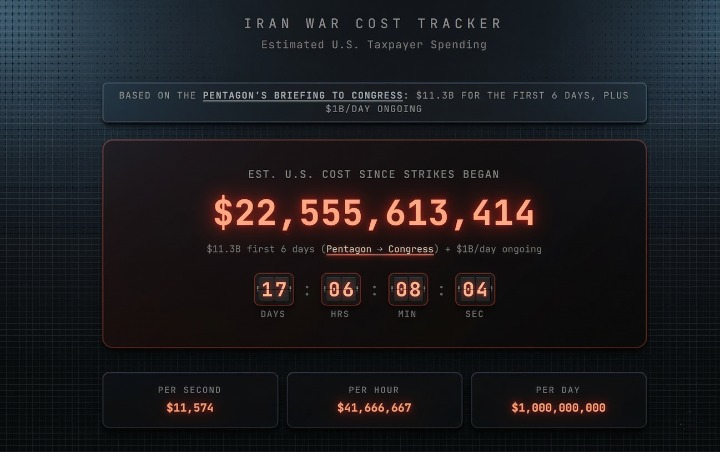
Operation Epic Fury, which began on February 28, 2026, is bleeding money at an unprecedented rate. According to the live tracker, the estimated U.S. taxpayer spending has already surged past a staggering $22.4 billion in just 17 days.

To put that into perspective, the United States is currently spending:
$1 billion per day
$41.6 million per hour
$11,574 every single second
The tracker bases its foundational data on a closed-door Pentagon briefing to Congress, which admitted that the first six days alone cost $11.3 billion. Senator Chris Coons has already indicated that this is likely an undercount, as it excludes the total cost of munitions replacement and the pre-war military buildup.
Where is this money going? The site meticulously logs the operational expenses. We are seeing $12.7 million THAAD interceptors and $3.7 million Patriot missiles being fired to shoot down $35,000 Iranian Shaheed drones—an unsustainable cost ratio of 106 to 1. In the first 48 hours alone, an estimated $10 billion was spent just on air defense. The tracker also logs massive individual losses, such as the three U.S. F-15EX fighter jets accidentally shot down by friendly Kuwaiti fire (a $309 million loss), and five KC-46 refueling aircraft damaged on the ground in Saudi Arabia ($750 million).
The Human Cost Behind the Numbers
While the financial ticker rolls, the human toll is categorized with equal transparency. The conflict has claimed the lives of 13 U.S. service members, with 140 wounded. On the Iranian side, over 2,096 military personnel and at least 1,382 civilians have been killed. A separate counter for the connected conflict in Lebanon shows an additional 486+ deaths and nearly 700,000 people displaced following Israel’s ground incursion and airstrikes.
The Inflation Trigger: Why the World Will Pay the Price

While the immediate military costs are borne by U.S. taxpayers, the Iran War Cost Tracker highlights a much more insidious threat: global inflation. The tracker features a “Pain at the Pump” module, and the data there is the canary in the coal mine for the global economy.
The conflict is situated directly on top of the world’s most critical energy artery. Approximately 20% of the globe’s daily oil supply moves through the Strait of Hormuz. Because of the ongoing strikes, the global energy market is panicking.
Here is how the war is guaranteed to export inflation worldwide:
The Oil Price Surge: Brent crude has already spiked past $102.91 per barrel. In the U.S., the national average for regular gasoline jumped 25%—from $2.96 to $3.70 per gallon—in a matter of weeks. The AAA reports this as the fastest weekly increase since Russia invaded Ukraine in 2022.
Targeted Energy Infrastructure: The warfare has rapidly expanded into energy hubs. The U.S. and Israel have struck oil storage facilities in Tehran and Alborz, and deployed stealth bombers to decimate military targets on Khaarg Island—Iran’s main oil export hub. In retaliation, intercepted Iranian drone debris ignited a fire at the UAE’s Fujairah oil terminal, a massive bunkering hub that handles 1 million barrels of crude a day, forcing a suspension of oil-loading operations.
The Ripple Effect: When oil prices skyrocket, the cost of manufacturing, logistics, shipping, and agriculture all follow suit. Companies do not absorb these costs; they pass them directly to consumers. The Penn Wharton Budget Model estimates that the total economic impact of this conflict could reach up to $210 billion.
A Depleted Arsenal and a Bleak Economic Forecast
Perhaps the most alarming detail buried in the tracker is the rate of stockpile depletion. At the current pace of interception, the entire U.S. supply of THAAD and SM-3 interceptors could be exhausted in just four to five weeks. Replacing them takes months, even at quadrupled production rates.
The Iran War Cost Tracker strips away the sanitized political language of “strategic strikes” and “containment,” leaving us with raw, terrifying math. The U.S. is burning billions to sustain the fight, but as the oil markets destabilize and global shipping routes are threatened, it is the everyday citizen—at the grocery store checkout and the gas pump—who will ultimately foot the bill.
Do follow our page: https://themorningdraft.com/